Featured Post

9th August 2016 Current Affairs Questions and Answers

9th August 2016 Current Affairs MCQs, Quiz, Questions : Current Affairs for August 2016 ,  Daily Multiple Choice Questions (MCQs) for In...

Showing posts with label Articles. Show all posts

J&K Reorganisation Bill 2019 passed in Rajya Sabha

Jammu and Kashmir Reorganisation Bill, 2019 passed in the Rajya Sabha today. It also moved a resolution revoking Article 370 from Jammu and Kashmir. Home Minister Amit Shah introduced the bill as well as moved the resolution in the House. Opposition members belonging from Congress, Left, TMC, SP, PDP, RJD and others created uproar in the House after the Minister’s announcement. The agitating members are sitting in the well and raising slogans.  Rajya Sabha adopts Jammu and Kashmir Reorganisation Bill, 2019, 125 vote for 61 vote against and 1 member abstains. The Bill is passed by the Rajya Sabha.
Earlier, Leader of the Opposition, Ghulam Nabi Azad demanded discussion on the prevailing situation in the state. Mr Azad said curfew has been imposed and prominent leaders put under house arrest. Home Minister Amit Shah said, government is ready to discuss every issue related to Jammu and Kashmir. Lok Sabha will discuss the resolutions regarding Jammu and Kashmir on Tuesday. Earlier, Home Minister Amit Shah moved a resolution to scrap provisions of Article 370 and Bills to bifurcate Jammu and Kashmir to make Ladakh a Union Territory and make a residual State a Union Territory with Legislative Assembly.

15th Finance Commission Chairman, Members, Report, Recommendations

15th Finance Commission Chairman, Members, Report, Recommendations, Important facts:
  • 15th Finance Commission: Union Cabinet chaired by the Prime Minister Narendra Modi has approved the setting up of the 15th Finance Commission on 22nd November 2017. 
  • 15th Finance Commission Chairman: Government on 27th November appointed former Planning Commission Member N K Singh as chairman of 15th Finance Commission.
  • 15th Finance Commission term: Under Article 280 (1) of the Constitution, it is a Constitutional obligation. The Terms of Reference for the 15th Finance Commission will be notified in due course of time.  In terms of Constitutional provisions, setting up the 15th Finance Commission, the recommendations of which will cover the five years commencing on April 1, 2020, has now become due.  It is expect that 15th Finance commission will have duration year 2020 to 2025.
  • 15th Finance Commission Members: The members of the Commission and its terms of reference will be notified in due course of time, Finance Minister Arun Jaitley said after the Union Cabinet meeting.
  • 15th Finance Commission Duration: Its recommendations will have to be in place before April 1, 2020, he said. "Normally, it takes 2 years for Finance Commission to give its recommendations."
  • Finance Commission Background
    • Article 280(1) of the Constitution lays down that a Finance Commission (FC) should be constituted "...within two years from the commencement of this Constitution and thereafter at the expiration of every fifth year or at such earlier time as the President considers necessary...". 
    • In keeping with this requirement, the practice has generally been to set up next Finance Commission within five years of the date of setting up of the previous Finance Commission. 
    • 14th Finance Commission was set up on January 2, 2013.  It was headed by Dr. Y. V Reddy with Operational Duration of April 1, 2015 to March 31, 2020.

National Health Policy, 2017

National Health Policy, 2017: Union Cabinet chaired by the Prime Minister Shri Narendra Modi in its meeting on 15th March 2017, has approved the National Health Policy, 2017 (NHP, 2017). Making a statement in the House a day after the Union Cabinet approved the policy, he said it seeks to move healthcare away from sick care to wellness, with a thrust on prevention and health promotion.

About National Health Policy, 2017:

  • It aims at achieving universal health coverage and delivering quality health care services to all at affordable cost.
  • The main objective of the National Health Policy 2017 is to achieve the highest possible level of good health and well-being, through a preventive and promotive health care orientation in all developmental policies, and to achieve universal access to good quality health care services without anyone having to face financial hardship as a consequence.
  • National Health Policy would aim at increasing life expectancy to 70 years from 67.5.
  • Reduce fertility rate to 2.1 by 2025.
  • Proposes free diagnostics and drugs at all public hospitals.
  • NHP, 2017 advocates a positive and proactive engagement with the private sector for critical gap filling towards achieving national goals. 
  • The broad principles of the policy is centered on Professionalism, Integrity and Ethics, Equity, Affordability, Universality, Patient Centered & Quality of Care, Accountability and pluralism.
  • In order to leverage the pluralistic health care legacy, the policy recommends mainstreaming the different health systems. Towards mainstreaming the potential of AYUSH the policy envisages better access to AYUSH remedies through co-location in public facilities. 
  • Yoga would also be introduced much more widely in school and work places as part of promotion of good health.
  • The policy advocates extensive deployment of digital tools for improving the efficiency and outcome of the healthcare system and proposes establishment of National Digital Health Authority (NDHA) to regulate, develop and deploy digital health across the continuum of care.
  • Government of India formulated the Draft National Health Policy and placed it in public domain on 30th December, 2014. Thereafter following detailed consultations with the stakeholders and State Governments, based on the suggestions received, the Draft National Health Policy was further fine-tuned. It received the endorsement of the Central Council for Health & Family Welfare, the apex policy making body, in its Twelfth Conference held on 27th February, 2016.
  • The last health policy was formulated in 2002.

Minimum Support Price (MSP), C2 Cost, C3 Cost and CACP Methodology

Minimum Support Price (MSP), C2 Cost, C3 Cost and CACP Methodology:
Minimum Support Price (MSP)
  • Price Support Policy of the Government is directed at providing insurance to agricultural producers against any sharp fall in farm prices. The minimum guaranteed prices are fixed to set a floor below which market prices cannot fall.
  • MSP were announced by the Government of India for the first time in 1966-67 for Wheat in the wake of the Green Revolution and extended harvest, to save the farmers from depleting profits.
  • Till the mid 1970s, Government announced two types of administered prices :
    • Minimum Support Prices (MSP)
    • Procurement Prices
  • This policy of two official prices being announced continued with some variation upto 1973-74, in the case of paddy. In the case of wheat it was discontinued in 1969 and then revived in 1974-75 for one year only. Since there were too many demands for stepping up the MSP, in 1975-76, the present system was evolved in which only one set of prices was announced for paddy (and other kharif crops) and wheat being procured for buffer stock operations.
  • MSP is announced by the Government of India for 25 crops currently at the beginning of each season viz. Rabi and Kharif. 
  • Following are the 25 crops covered by MSP
    • Kharif Crops: Paddy, Jowar, Bajra, Maize, Ragi, Arhar(Tur), Moong, Urad, Cotton, Groundnut, Sunflower Seed, Soyabeen Black, Sesamum, Nigerseed
    • Rabi Crops: Wheat, Barley,Gram, Masur (Lentil), Rapeseed/Mustard, Safflower, Toria
    • Other Crops: Copra, De-Husked Coconut, Jute, Sugarcane
CACP's Methodology for Cost Calculation
  • Minimum Support Price for major agricultural products are announced each year after taking into account the recommendations for the commission for agricultural costs and prices (CACP).
  • The CACP while recommending prices takes into account all important factors including cost of production, changes in input prices, input/output parity, trends in market prices, inter crop price parity, Demand and supply situation, parity between prices paid and prices received by farmers etc. 
  • In fixing the support prices, CACP relies on the cost concept which covers all items of expenses of cultivation including that the imputed value of the inputs owned by farmers such as rental value of owned land and interest on fixed capital. some of the important cost concepts used by CACP are the C2 and C3 Costs. 
    • C2 Cost: C2 cost includes all actual expenses in cash and kind incurred in production by actual owner + rent paid for leased land + imputed value of family labour + interest on the value of owned capital assets (excluding land) + rental value of owned land (net of land revenue)
    • C3 Cost: Cost C2 + 10% of cost C2 to account for managerial remuneration to the farmer.
  • Costs of production are calculated both on a per quintal and per hectare basis. Since cost variation are large over states. CACP recommends that MSP should be considered on the basis of C2 Cost.  However increases in MSP have been so substantial in case of paddy and what that in most of the states MSPs are way above not only the C2 cost but the C3 cost as well.
Question in RAS Exam 2016:
Since 1997-98, which statement is correct regarding Minimum Support Price (MSP)?
A. MSP is independent to C2 Cost
B. MSP<C2 costs
C. MSP>C2 costs
D. MSP=C2 cost
Answer: C

Rocks Types: Igneous, Sedimentary and Metamorphic rocks

Types of Rocks: Earth’s crust is made up of various types of rocks. Any natural mass of mineral matter that makes up the earth’s crust is called a rock. Rocks can be of different colour, size and texture. There are three major types of rocks: igneous rocks, sedimentary rocks and metamorphic rocks.

  1. Igneous Rocks: When the molten magma cools, it becomes solid. Rocks thus formed are called igneous rocks. They are also called primary rocks. There are two types of igneous rocks: intrusive rocks and extrusive rocks.
    • Intrusive Rocks: When molten lava comes on the earth’s surface, it rapidly cools down and becomes solid. Rocks formed in such a way on the crust are called extrusive igneous rocks. They have a very fine grained structure. For example, basalt. The Deccan plateau is made up of basalt. 
    • Extrusive Rocks: Sometimes the molten magma cools down deep inside the earth’s crust. Solid rocks so formed are called intrusive igneous rocks. Since they cool down slowly they form large grains. Granite is an example of such a rock. 
  2. Sedimentary Rocks: Rocks roll down, crack, and hit each other and are broken down into small fragments. These smaller particles are called sediments. These sediments are transported and deposited by wind, water, etc. These loose sediments are compressed and hardened to form layers of rocks. These types of rocks are called sedimentary rocks. For example, sandstone is made from grains of sand. 
  3. Metamorphic rocks: Igneous and sedimentary rocks can change into metamorphic rocks under great heat and pressure. For example, clay changes into slate and limestone into marble.

Barter System

Barter System is a trade in which goods are exchanged without the use of money. This system has been used for centuries and long before money was invented. People exchanged services and goods for other services and goods in return. In ancient times, this system involved people in the same area, however today bartering is global. The value of bartering items can be negotiated with the other party. 
The history of bartering dates all the way back to 6000 BC. Introduced by Mesopotamia tribes, bartering was adopted by Phoenicians. Phoenicians bartered goods to those located in various other cities across oceans. Babylonian's also developed an improved bartering system. Goods were exchanged for food, tea, weapons, and spices. In the Middle Ages, Europeans traveled around the globe to barter crafts and furs in exchange for silks and perfumes. Due to lack of money, bartering became popular in the 1930s during the Great Depression. It was used to obtain food and various other services.

Earth's Atmosphere Layers

Earth's Atmosphere Layers: The Earth's atmosphere is divided into 5 layers. It is thickest near the surface and thins out with height until it eventually merges with space. Moving upward from ground level, these layers are named the troposphere, stratosphere, mesosphere, thermosphere and exosphere. The exosphere gradually fades away into the realm of interplanetary space.

  1. Troposphere: The troposphere starts at the Earth's surface and extends 8 to 14.5 kilometers high. This part of the atmosphere is the most dense. Almost all weather is in this region.
  2. Stratosphere: The stratosphere starts just above the troposphere and extends to 50 kilometers  high. Commercial passenger jets fly in the lower stratosphere, partly because this less-turbulent layer provides a smoother ride. The jet stream flows near the border between the troposphere and the stratosphere. The ozone layer, which absorbs and scatters the solar ultraviolet radiation, is in this layer.
  3. Mesosphere: The mesosphere starts just above the stratosphere and extends to 85 kilometers  high. Most meteors burn up in the mesosphere. Unlike the stratosphere, temperatures once again drop as you rise up through the mesosphere. The coldest temperatures in Earth's atmosphere, about -90° C (-130° F), are found near the top of this layer. 
  4. Thermosphere: The thermosphere starts just above the mesosphere and extends to 600 kilometers high. Aurora and satellites occur in this layer.
  5. Exosphere: The atmosphere merges into space in the extremely thin exosphere. This is the upper limit of our atmosphere. The exosphere is the most distant atmospheric region from Earth's surface. In the exosphere, an upward travelling molecule can escape to space (if it is moving fast enough) or be pulled back to Earth by gravity with little probability of colliding with another molecule. The exosphere is a transitional zone between Earth's atmosphere and interplanetary space.

National Green Tribunal (NGT)

National Green Tribunal (NGT)

  • National Green Tribunal has been established on 18.10.2010 under the National Green Tribunal Act 2010 for effective and expeditious disposal of cases relating to environmental protection and conservation of forests and other natural resources including enforcement of any legal right relating to environment and giving relief and compensation for damages to persons and property and for matters connected therewith or incidental thereto. 
  • It is a specialized body equipped with the necessary expertise to handle environmental disputes involving multi-disciplinary issues. 
  • The Tribunal shall not be bound by the procedure laid down under the Code of Civil Procedure, 1908, but shall be guided by principles of natural justice. It draws inspiration from the India's constitutional provision of Article 21, which assures the citizens of India the right to a healthy environment.
  • The Tribunal is mandated to make and endeavour for disposal of applications or appeals finally within 6 months of filing of the same. 
  • On 18 October 2010, Justice Lokeshwar Singh Panta became its first Chairman. Currently it is chaired by Justice Swatanter Kumar since 20 Dec 2012.
  • National Green Tribunal (NGT) is in News recently after green panel said that diesel vehicles which are 15- years-old should be de-registered first and will not get No Objection Certificate (NoC) for plying outside Delhi-NCR.

Earthquake Waves

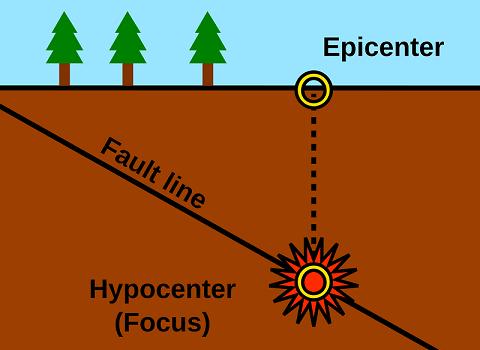
Earthquake in simple words is shaking of the earth. It is a natural event. It is caused due to release of energy, which generates waves that travel in all directions. 
  • The point where the energy is released is called the focus of an earthquake, alternatively, it is called the hypocentre
  • The energy waves travelling in different directions reach the surface. The point on the surface, nearest to the focus, is called epicentre.
  • All natural earthquakes take place in the lithosphere or earth consisting of solid rocks. An instrument called ‘seismograph’ records the waves reaching the surface.
  • The earthquake events are scaled either according to the magnitude or intensity of the shock. The magnitude scale is known as the Richter scale.
Earthquake Waves: There are Three types of Earthquake Waves. They are called P-waves, S-waves and surface waves. 

  1. P-waves or ‘primary waves’ move faster and are the first to arrive at the surface. They travel through gaseous, liquid and solid materials. 
  2. S-waves or secondary waves arrive at the surface with some time lag.  
  3. Surface waves are the last to report on seismograph. These waves are more destructive. They cause displacement of rocks, and hence, the collapse of structures occurs.
Check Geography Notes at Geography of World and India or Notes section of INDIA GK Mobile App. 

Civil Aviation Policy 2016

Civil Aviation Policy 2016:  Union Cabinet chaired by the Prime Minister Shri Narendra Modi has given its approval for the New Civil Aviation Policy on 15th June 2016. This is the first time since Independence that an integrated Civil Aviation Policy has been brought out by the Ministry of Civil Aviation. 

Civil Aviation Policy 2016 Aims:

  • India to become 3rd largest civil aviation market by 2022 from 9th
  • Domestic ticketing to grow from 8 crore in 2015 to 30 crore by 2022
  • Airports having scheduled commercial flights to increase from 77 in 2016 to 127 by 2019
  • Cargo volumes to increase by 4 times to 10 million tonnes by 2027
  • Taking flying to masses – Enabling Indians to fly at Rs. 2,500 per hour under Regional Connectivity Scheme at unserved airports
  • Requirement of 5 years of domestic flying for starting international operations removed
  • Flexible and liberalized ‘open skies’ and ‘code share’ agreements
  • Incentives to MRO sector to develop as hub for South Asia
  • Ensuring availability of quality certified 3.3 lakh skilled personnel by 2025
  • Development of green-field airports and heliports
  • Enhancing ease of doing business through deregulation, simplified procedures and e-governance
  • Promoting ‘Make In India’ in Civil Aviation Sector

Civil Aviation Policy 2016 Salient features:
  • The Viability Gap Funding (VGF) will be funded by a small levy per departure on all domestic routes other than Cat II/ Cat IIA routes, RCS routes and small aircraft at a rate as decided by the Ministry from time to time. 
  • The 5/20 rule for commencement of international flight in operation since 2004 is replaced by a formulation which provides a level playing field and allows airlines, both new and old, to commence international operations provided they continue to meet some obligation for domestic operation.
  • Necessary administrative and financial flexibility will be provided to Director General of Civil Aviation (DGCA) for an effective aviation safety oversight system and for creating a transparent single-window system for all aviation safety related issues.
  • The Route Dispersal Guidelines (RDG)  have been  rationalised by making the criteria for declaring a route as Category I (trunk route) more transparent, while the traffic to be deployed on Cat II and IIA expressed in terms of a percentage of CAT I traffic remains the same. 
  • The regime of bilateral rights and code share agreements will be liberalised leading to greater ease of doing business and wider choice to passengers. “Open skies” will be implemented on a reciprocal basis for SAARC countries and countries beyond 5000 kms from Delhi. 
  • The Ministry will continue to encourage development of airports by the State Government or the private sector or in PPP mode and endeavour to provide regulatory certainty. Future greenfield and brownfield airports will have cost efficient functionality with no compromise on safety and security.
  • Airport Authority of India (AAI) will continue to develop and modernise its airports and upgrade quality of services. AAI will be suitably compensated in case a new greenfield airport is approved in future within 150 km radius of an existing operational AAI airport which is not yet saturated.
  • Upgradation and modernisation of Air Navigation Services will continue in line with global trends. AAI will provide a fully harmonised Air Navigation System considering International Civil Aviation Organisation (ICAO) Global Air Navigation Plan, Aviation system Block Upgrade and modern performance based technologies and procedures.
  • The Government will promote helicopter usage by issuing separate regulations for helicopters and development of four heli-hubs initially. Ministry of Civil Aviation will also coordinate with all the agencies and stakeholders concerned to facilitate Helicopter Emergency Medical Services.
  • The existing ground handling policy is being replaced with a new framework to ensure fair competition. The airport operator will ensure that there will be three Ground Handling Agencies (GHA) including Air India's subsidiary/JV at all major airports as defined in AERA Act 2008. At  non-major airports, the airport operator to decide on the number of ground handling agencies, based on the traffic output, airside and terminal building capacity. All domestic scheduled airline operators including helicopter operators will be free to carry out self-handling at all airports. Hiring of employees through manpower supplier will not be permitted.

Janani Shishu Suraksha Karyakaram (JSSK)

Janani Shishu Suraksha Karyakaram (JSSK) has been launched on 1st June, 2011, and it entitles all pregnant women delivering in public health institutions to absolutely free and no expense delivery including Caesarean section.  The initiative stipulates free drugs, diagnostics, blood and diet, besides free transport from home to institution, between facilities in case of a referral and drop back home.  Similar entitlements have been put in place for all sick infants accessing public health institutions for treatment.
As public health is a State subject, all programmes under NHM are being implemented by the State/UT Government and support to State/UT Government under NHM is provided based on the proposals in their respective Programme Implementation Plans (PIPs). In recent years, NHM division has not given any TA/DA norms. It is generally decided by the State Health Society.

Plastic Waste Management Rules, 2016

Plastic Waste Management Rules, 2016: Government has notified the Plastic Waste Management Rules, 2016, in suppression of the earlier Plastic Waste (Management and Handling) Rules, 2011.   The Minister of State for Environment, Forest and Climate Change, Shri Prakash Javadekar, said here today that the minimum thickness of plastic carry bags has been increased from 40 microns to 50 microns.  He stated that 15, 000 tonnes of plastic waste is generated every day, out of which 9, 000 tonnes is collected and processed, but 6, 000 tonnes of plastic waste is not being collected.  Shri Javadekar also said that the rules, which were admissible upto municipal areas, have now been extended to all villages.
The Plastic Waste Management Rules, 2016 aim to:

  • Increase minimum thickness of plastic carry bags from 40 to 50 microns and stipulate minimum thickness of 50 micron for  plastic sheets also to facilitate collection and recycle of plastic waste,
  • Expand the jurisdiction of applicability from the municipal area to rural areas, because plastic has reached rural areas also;
  • To bring in the responsibilities of producers and generators, both in plastic waste management system and to introduce collect back system of plastic waste by the producers/brand owners, as per extended producers responsibility;
  • To introduce collection of plastic waste management fee through pre-registration of the producers, importers of plastic carry bags/multilayered packaging and vendors selling the same for establishing the waste management system; 
  • To promote use of plastic waste for road construction as per Indian Road Congress guidelines or energy recovery, or waste to oil etc. for gainful utilization of waste and also address the waste disposal issue; to entrust more responsibility on waste generators, namely payment of user charge as prescribed by local authority, collection and handing over of waste by the institutional generator, event organizers.

Juvenile Justice Act, 2015 comes into force from today, 15th January 2016

Juvenile Justice (Care and Protection of Children) Act, 2015 has come into force from today,15th January 2016 and repeals the Juvenile Justice (Care and Protection of Children) Act, 2000. The Juvenile Justice (Care and Protection of Children) Bill, 2015 was passed by Lok Sabha on 7th May, 2015; was passed by Rajya Sabha on 22nd December, 2015 and received Presidential assent on 31st December, 2015. The JJ Act, 2015 provides for strengthened provisions for both children in need of care and protection and children in conflict with law.
Juvenile Justice Act, 2015 Highlights
  • Change in nomenclature from ‘juvenile’ to ‘child’ or ‘child in conflict with law’, across the Act to remove the negative connotation associated with the word “juvenile”;  inclusion of several new definitions such as orphaned, abandoned and surrendered children; and petty, serious and heinous offences committed by children. 
  • Clarity in powers, function and responsibilities of Juvenile Justice Board (JJB) and Child Welfare Committee (CWC); clear timelines for inquiry by Juvenile Justice Board (JJB).
  • Special provisions for heinous offences committed by children above the age of sixteen year; separate new chapter on Adoption to streamline adoption of orphan, abandoned and surrendered children; inclusion of new offences committed against children; and mandatory registration of Child Care Institutions. 
  • Under Section 15, special provisions have been made to tackle child offenders committing heinous offences in the age group of 16-18 years. The Juvenile Justice Board is given the option to transfer cases of heinous offences by such children to a Children’s Court (Court of Session) after conducting preliminary assessment.
  • To streamline adoption procedures for orphan, abandoned and surrendered children, the existing Central Adoption Resource Authority (CARA) is given the status of a statutory body to enable it to perform its function more effectively.
  • Several new offences committed against children, which are so far not adequately covered under any other law, are included in the Act. These include: sale and procurement of children for any purpose including illegal adoption, corporal punishment in child care institutions, use of child by militant groups, offences against disabled children and, kidnapping and abduction of children. 
  • All child care institutions, whether run by State Government or by voluntary or non-governmental organisations, which are meant, either wholly or partially for housing children, regardless of whether they receive grants from the Government, are to be mandatorily registered under the Act within 6 months from the date of commencement of the Act. Stringent penalty is provided in the law in case of non-compliance.

Pradhan Mantri Fasal Bima Yojana

Pradhan Mantri Fasal Bima Yojana: Union Cabinet has approved Pradhan Mantri Fasal Bima Yojana, a new crop insurance scheme to boost farming sector in the country. It is farmers’ welfare scheme that aims to reduce the premium burden on farmers and ensure early settlement of crop assurance claim for the full insured sum.  The new Crop Insurance Scheme is in line with One Nation – One Scheme theme.  It incorporates the best features of all previous schemes and at the same time, all previous shortcomings/weaknesses have been removed.
Highlights of Pradhan Mantri Fasal Bima Yojana:
  • There will be a uniform premium of only 2% to be paid by farmers for all Kharif crops and 1.5% for all Rabi crops. In case of annual commercial and horticultural crops, the premium to be paid by farmers will be only 5%. 
  • The premium rates to be paid by farmers are very low and balance premium will be paid by the Government to provide full insured amount to the farmers against crop loss on account of natural calamities.
  • There is no upper limit on Government subsidy. Even if balance premium is 90%, it will be borne by the Government.
  • Earlier, there was a provision of capping the premium rate which resulted in low claims being paid to farmers. This capping was done to limit Government outgo on the premium subsidy. This capping has now been removed and farmers will get claim against full sum insured without any reduction.
  • The use of technology will be encouraged to a great extent. Smart phones will be used to capture and upload data of crop cutting to reduce the delays in claim payment to farmers. Remote sensing will be used to reduce the number of crop cutting experiments.
  • In order to reduce the delays in claim payment to farmers, smart phones will be used to capture and upload data of crop cutting.  To reduce the number of crop cutting experiments remote sensing will be used.

Strategic planning Vs Tactical planning

Strategic planning is an organization's process of defining its strategy, or direction, and making decisions on allocating its resources to pursue this strategy. It may also extend to control mechanisms for guiding the implementation of the strategy.
Tactical planning takes a company's strategic plan and sets forth specific short-term actions and plans, usually by company department or function. The tactical planning horizon is shorter than the strategic plan horizon.
In business usage, the term strategy is the thinking process required to plan a change or to organize something. It defines the goals desired and how to achieve them. It can be a compendium of complex multi-layered plans devised for achieving preset objectives and may include tactical planning considerations. Tactics are the substance of strategy. They comprise what is done pursuant to strategic planning. The strategic phase of business planning has thinkers (you- the small business owner) determining ways to achieve stated goals. Simply stated, they plan how people need to act in order to attain the objectives for which the strategy is to be used.
Difference between Strategy and Tactics

Strategy Tactics
Purpose To identify clear broader goals that advance the overall organization and organize resources. To utilize specific resources to achieve sub-goals that support the defined mission.
Roles Individuals who influence resources in the organization. They understand how a set of tactics work together to achieve goals. Specific domain experts that maneuver limited resources into actions to achieve a set of goals.
Accountability Held accountable to overall health of organization. Held accountable to specific resources assigned.
Scope All the resources within the organizations, as well as broader market conditions including competitors, customers, and economy.  Yet don’t over think it, to paraphrase my business partner Charlene Li, “Strategy is often what you don’t do”. A subset of resources used in a plan or process. Tactics are often specific tactics with limited resources to achieve broader goals.
Duration Long Term, changes infrequently. Shorter Term, flexible to specific market conditions.
Methods Uses experience, research, analysis, thinking, then communication. Uses experiences, best practices, plans, processes, and teams.
 Outputs Produces clear organizational goals, plans, maps, guideposts, and key performance measurements. Produces clear deliverables and outputs using people, tools, time.

QUIZ. Which of the following would NOT be an accurate depiction of the differences between strategic and tactical planning?
A. Strategic planning is developed mainly by upper-level management and tactical planning is generally developed by lower-level management
B.   Facts for strategic planning are generally easier to gather than facts for tactical planning
C.   Strategic plans generally contain less details than tactical plans
D.   Strategic plans generally cover a longer period of time than tactical plans
Answer: B


For More Objective Questions on General Management Download our Free "INDIA GK" Mobile App: https://play.google.com/store/apps/details?id=com.csurender.dune.indiagk

All India Council of Sports (AICS)

Government of India has constituted All India Council of Sports (AICS) headed by Prof V.K. Malhotra as its President in the rank of Minister of State in July 2015. Its members include eminent sportspersons and coaches like Shri Sachin Tendulkar, Smt. P.T. Usha, Shri Limba Ram, Ms. N. Kunjarani Devi, Shri I.M. Vijayan, Shri P. Gopichand, Shri Baichung Bhutia and Shri Vishwanathan Anand. 
The Objectives of the AICS are follows:
  • Popularizing sports amongst the youth as a way of life.
  • Increasing outreach of sports to rural and tribal areas, and areas affected by Left Wing Extremism (LWE), North East and Jammu & Kashmir;
  • Matters relating to promotion of inclusiveness in sports with special focus on women, differently-abled, tribals etc
  • Preventing drug abuse in sports, fraud of age and harassment of women in sports
  • Bringing professionalism, transparency and good governance in functioning of national sports federations
  • Early identification of sports talent and nurturing of the identified talent; and Integration of sports in educational curriculum in schools, colleges and universities
  • Promotion of sports sciences and sports medicine
  • Issues and matters specifically referred to the council by the ministry of youth affairs and sports.

Major Achievements of India since Independence

15 Major Achievements of India since Independence: It is not true that India has done nothing and not achieved in past 65 years of Independence Day. Post independence despite not having access to electricity, roads, better education, high level equipment and wealth, India has consistently doled out stalwarts in the fields of science, technology and social reforms.We believed there might be up and down but India achieved many things in last 65 years and here is Major Achievements of India since Independence under various prime ministers of India and people of India.
15 Major Achievements of India since Independence:
1. Creating The Republic: India became an independent nation within the British Commonwealth on 15 August 1947. The Constitution was adopted by the India Constituent Assembly on 26 November 1949, and came into effect on 26 January 1950.

2. Construction of New India with Dams and irrigation Projects.

Bhakra Dam (226 M) is a concrete gravity dam across the Sutlej River in Himachal Pradesh.
3. Heavy Industry in India.
Bombay High is an offshore oilfield by ONGC 162 kilometres off the coast of Mumbai.
4. Panchayat Raj system to Empower Rural India.
Panchayat Raj System was first adopted by the state of Rajsthan in Nagaur district on 2nd Oct 1959
5. Green Revolution is identified with India's being catapulted from a chronically food-short country, with a begging-bowl image, to one which was self-sufficient and which became over time even surplus in food. The change follows the major technological reforms that occurred in Indian agriculture, particularly from the mid-1960s. 
6. India-Pakistan War & Liberating Bangladesh, 1971
December 1971: Lt.Gen. AAK.Niazi (right) of Pakistan signs the surrender documents.
7. Pokharan 1 or 'Smiling Buddha' - India's first nuclear test by Prime Minister Indira Gandhi. Smiling Buddha (Pokhran-I) was the assigned code name of India's first successful nuclear bomb test on 18 May 1974. The bomb was detonated on the army base, Pokhran Test Range (PTR), in Rajasthan by the Indian Army under the supervision of several key army officials.

8. Jawahar Navodaya Vidyalaya, 1985: Jawahar Navodaya Vidyalayas (JNVs) are a system of alternate schools for gifted students in India. There are approximately 600 JNVs across India (one school per district). JNVs are specifically tasked with finding talented children in rural areas of India and providing them with an education equivalent to the best residential school system, without regard to their family's socio-economic condition.
9. Rise of IT industry (1998-2008): Information technology in India is an industry consisting of two major components: IT services and business process outsourcing (BPO). The sector has increased its contribution to India's GDP from 1.2% in 1998 to 7.5% in 2012.
10. Golden quadrilateral and other new highways - Over 40,000 km of highways/expressways added in the past 15 years. The Golden Quadrilateral is a highway network connecting many of the major industrial, agricultural and cultural centres of India. A quadrilateral of sorts is formed by connecting Chennai, Kolkata, Delhi and Mumbai, and hence its name.

11. PMGSY, 2000: Pradhan Mantri Gram Sadak Yojana (PMGSY) is a nationwide plan in India to provide good all-weather road connectivity to unconnected villages.

12. Right to Information (RTI) Act. that has turned thorn in govt flesh. Right to Information Act (RTI) is an Act of the Parliament of India "to provide for setting out the practical regime of right to information for citizens" and replaces the erstwhile Freedom of information Act, 2002.
13. Chandrayaan: Chandrayaan-1 was India's first lunar probe. It was launched by the Indian Space Research Organisation (ISRO) in October 2008, and operated until August 2009. The mission included a lunar orbiter and an impactor.
14. Right to Education Act (RTE): Right of Children to Free and Compulsory Education Act or Right to Education Act (RTE), is an Act of the Parliament of India enacted on 4 August 2009, which describes the modalities of the importance of free and compulsory education for children between 6 and 14 in India under Article 21A of the Indian Constitution.
15. Polio Free India: Ending polio among 1.3 billion people in India is world's greatest health achievement.  World Health Organisation (WHO) South-East Asia Region, home to a quarter of the world’s population, was certified polio-free in March 2014 by an independent commission under the WHO certification process. This is the fourth of six WHO Regions to be certified, marking an important step towards global polio eradication. 

Jeevan Pramaan, Aadhar based Digital Life Certification system for Pensioners

Jeevan Pramaan” an Aadhar based Digital Life Certification system with an objective to facilitate on-line submission of Life Certificate by pensioners, was launched by the Prime Minister Shri Narendra Modi on 10th November, 2014. This facility is in addition to the other existing methods of submitting Life Certificates. It is hoped that all pensioners who have Aadhaar numbers will make use of this additional facility of biometric life certification.
With “Jeevan Pramaan” the pensioners and family pensioners need not visit the pension disbursing agency or Gazetted/designated authority for submission of Life Certificates. The Life Certificates may be submitted from personal computers and laptops at home or by visiting a conveniently located Common Service Centre or the nearest branch of any pension disbursing bank. There are about 55,000 branches of pension disbursing banks and 40,000 Common Service Centres throughout the country. Submission of Digital Life Certificate also ensures authenticity of pension payments.

Sustainable Sugarcane Initiative

Sustainable Sugarcane Initiative (SSI) aims at providing practical options to the farmers in improving the productivity of land, water and labour, all at the same time.  SSI is also expected to reduce the overall pressure on water resources and contribute to recovery of ecosystems. Sustainable Sugarcane Initiative is an innovative method of sugarcane production using less seeds, less water and optimum utilization of fertilizers and land to achieve more yields.
The major principles that govern SSI
  • Raising nursery in portrays using single budded chips
  • Transplanting young seedlings (25-35 days old)
  • Maintaining wider spacing (5x2 feet) in the main field
  • Providing sufficient moisture through efficient water management technologies viz.,drip fertigation (sub or sub surface)Encouraging organic method of nutrient and plant protection measures
  • Practicing intercropping with effective utilization of land
Overall benefits
  • Improved water use efficiency
  • Optimum use of fertilizers favour balanced availability of nutrients
  • Better aeration and more penetration of sunlight favours higher sugar content
  • Reduced cost of cultivation and increased returns  through intercropping

Montreux Record and Ramsar Convention on Wetland

Montreux Record and Ramsar Convention on Wetland: Ramsar Convention on Wetland was held in Ramsar, Iran, in 1971, is an intergovernmental treaty which provides the framework for national action and international  cooperation for the conservation and wise use of wetlands and their resources. There are presently 158 Contracting Parties to the Convention, with 1758 wetland  sites, totaling 161 million hectares, designated for inclusion in the Ramsar List of Wetlands of International Importance. Ramsar Convention is the only global environment treaty dealing with a particular ecosystem. The Ramsar Convention on Wetlands was developed as a means to call international attention to the rate at which wetland habitats were disappearing, in part due to a lack of understanding of their important functions, values, goods and services. Governments that join the  Convention are expressing their willingness to make a commitment to helping to reverse that history of wetland loss and degradation. The text of the Convention  and other details can be accessed on Ramsar Convention's website ( www.ramsar.org). World Wetlands Day which is celebrated each year on 2 February, marks the date of the adoption of the Convention on Wetlands on 2 February 1971, in the Iranian
Major obligations of countries which are party to the Convention are:
  • Designate wetlands for inclusion in the List of Wetlands of International Importance.
  • Promote, as far as possible, the wise use of wetlands in their territory.
  • Promote international cooperation especially with regard to transboundary wetlands, shared water systems, and shared species.
  • Create wetland reserves.
Montreux Record
  • Montreux Record under the Convention is a register of wetland sites on the List of Wetlands of International Importance where changes in ecological character have occurred, are occurring, or are likely to occur as a result of technological developments, pollution or other human interference. It is maintained as part of the Ramsar List.
  • The Montreux Record was established by Recommendation 4.8 of the Conference of the Contracting Parties (1990). 
  • Resolution 5.4 of the Conference (1993) determined that the Montreux Record should be employed to identify priority sites for positive national and international conservation attention. Sites may be added to and removed from the Record only with the approval of the Contracting Parties in which they lie. 
  • Convention on Wetlands came into force for India on 1 February 1982. 
  • India presently has 26 sites designated as Wetlands of International Importance, with a surface area of 689,131 hectares.
  • Total 26 Sites are:
    1. Ashtamudi Wetland, (Kerala)
    2. Bhitarkanika Mangroves, (Orissa)
    3. Bhoj Wetland, (Madhya Pradesh)
    4. Chandra Taal, (Himachal Pradesh)
    5. Chilika Lake, (Orissa)
    6. Deepor Beel, (Assam)
    7. East Calcutta Wetlands, (West Bengal)
    8. Harike Wetland, (Punjab)
    9. Hokera Wetland, (Jammu and Kashmir)
    10. Kanjli Wetland, (Punjab)
    11. Keoladeo National Park, (Rajasthan)
    12. Kolleru Lake, (Andhra Pradesh)
    13. Loktak Lake, (Manipur)
    14. Nalsarovar Bird Sanctuary, (Gujarat)
    15. Point Calimere Wildlife and Bird Sanctuary, (Tamil Nadu)
    16. Pong Dam Lake, (Himachal Pradesh)
    17. Renuka Lake, (Himachal Pradesh)
    18. Ropar_Wetland, (Punjab)
    19. Rudrasagar Lake, (Tripura)
    20. Sambhar Lake, (Rajasthan)
    21. Sasthamkotta Lake, (Kerala)
    22. Surinsar-Mansar Lakes, (Jammu and Kashmir)
    23. Tsomoriri, (Jammu and Kashmir)
    24. Upper Ganga River (Brijghat to Narora Stretch), (Uttar Pradesh)
    25. Vembanad-Kol Wetland, (Kerala)
    26. Wular Lake, (Jammu and Kashmir)